

You've probably heard the term "web marketing" thrown around in business conversations, but what does it really mean for your company in 2026? If you're running a small or medium-sized business in Burnaby, Surrey, or Vancouver, understanding how to market your business online isn't just nice to have anymore. It's essential. Web marketing encompasses all the strategies and tactics you use to promote your business on the internet, from search engine optimization to social media campaigns, and everything in between. The digital landscape has evolved dramatically, and the businesses that thrive are the ones that adapt their approach to meet customers where they are: online, searching for solutions, and ready to engage.
Understanding the Web Marketing Landscape
The web marketing world has transformed since the early days of simple banner ads and keyword stuffing. Today, you're working with a sophisticated ecosystem that requires both creativity and data-driven decision-making.
Think about how you search for products or services yourself. You probably start with Google, check out a few websites, read reviews, maybe watch a video, and then make your decision. Your customers do the same thing. This journey is what web marketing is all about: being present at every touchpoint.
The Core Components You Need to Know
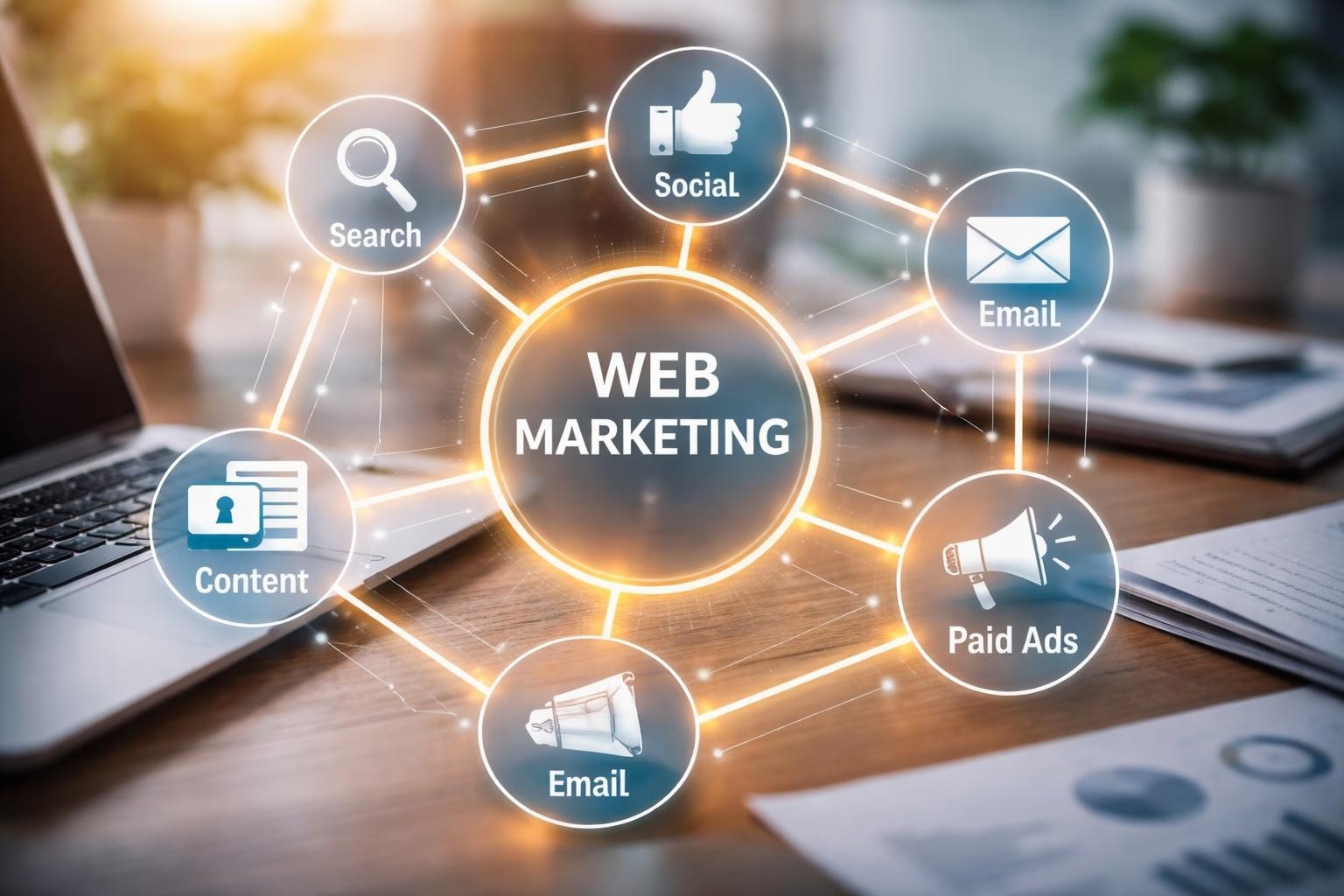
Modern web marketing isn't just one thing. It's a combination of multiple channels working together:
- Search Engine Optimization (SEO): Getting your website to rank higher in search results
- Content Marketing: Creating valuable information that attracts and engages your audience
- Pay-Per-Click Advertising (PPC): Running targeted ads on search engines and social platforms
- Social Media Marketing: Building community and engagement on platforms where your customers spend time
- Email Marketing: Nurturing relationships with prospects and customers directly in their inbox
- Website Optimization: Ensuring your site converts visitors into customers
Each of these channels plays a specific role in your overall strategy. The key is understanding which ones matter most for your business goals.

Building Your SEO Foundation
When someone in Vancouver searches for services you offer, does your business show up? If not, you're missing out on valuable opportunities. HubSpot’s marketing insights show that organic search remains one of the highest ROI channels for businesses.
Your SEO strategy starts with understanding what your customers are actually searching for. You might think they're looking for "digital marketing services," but they might actually be typing "how to get more customers online" or "best marketing agency near me."
Local SEO for Vancouver Area Businesses
For businesses serving specific areas like Burnaby, Surrey, and Vancouver, local SEO becomes even more critical. You need to:
- Claim and optimize your Google Business Profile with accurate information, photos, and regular updates
- Build local citations across relevant directories and platforms
- Gather authentic customer reviews that showcase your expertise and service quality
- Create location-specific content that addresses the unique needs of your community
- Ensure consistent NAP (Name, Address, Phone) information across all platforms
Your advertising and marketing campaigns in Burnaby need to reflect the local market's specific characteristics and search patterns.
| SEO Element | Impact Level | Time to Results | Difficulty |
|---|---|---|---|
| On-page optimization | High | 2-4 weeks | Low |
| Local listings | High | 1-3 weeks | Low |
| Quality backlinks | Very High | 3-6 months | High |
| Technical SEO | Medium | 4-8 weeks | Medium |
| Content creation | High | 2-6 months | Medium |
Content Marketing That Actually Converts
Here's where many businesses get stuck. They know they need content, but they're not sure what to create or how to make it work. Content marketing isn't about churning out blog posts for the sake of it. It's about creating resources that solve real problems for your audience.
What challenges do your customers face? What questions do they ask during sales conversations? Those are your content goldmines.
Creating Content That Resonates
Your content strategy should align with different stages of the customer journey. Someone just becoming aware of a problem needs different information than someone ready to make a purchase decision.
For awareness-stage content, focus on educational pieces that help people understand their challenges. The Content Marketing Institute emphasizes the importance of audience-first thinking in all content creation.
- Blog posts that answer specific questions your customers are asking
- Videos demonstrating your expertise or explaining complex concepts
- Infographics that simplify industry data or processes
- Case studies showing real results you've achieved for clients
- Guides and resources that provide comprehensive information on key topics
Consideration-stage content should help prospects evaluate their options. This is where comparison articles, detailed service explanations, and website design and development insights become valuable.

Paid Advertising in the Digital Space
While organic web marketing strategies build long-term value, paid advertising delivers immediate visibility. The beauty of digital advertising in 2026 is the precision targeting available to you.
You can reach people based on their location, interests, search behavior, demographics, and even their past interactions with your website. This means every dollar you spend can be directed toward people most likely to become customers.
Choosing the Right Advertising Platforms
Not every platform makes sense for every business. Here's how to think about it:
Google Ads work exceptionally well when people are actively searching for what you offer. If you provide emergency services or solve urgent problems, search ads are your friend.
Facebook and Instagram Ads excel at building awareness and reaching people who fit your customer profile but aren't necessarily searching right now. These platforms are powerful for building brand recognition.
LinkedIn Ads make sense if you're targeting other businesses or professionals in specific industries.
YouTube Ads can be cost-effective for building awareness and explaining complex services or products.
The data from Think with Google consistently shows that businesses using multiple channels in coordination see better overall results than those focusing on just one.
Optimizing Your Website for Conversions
You can drive all the traffic in the world to your website, but if it doesn't convert visitors into leads or customers, you're wasting your web marketing investment.
Your website is your digital storefront. When someone lands on your site, do they immediately understand what you offer and why they should choose you? Can they easily find what they're looking for? Is it obvious what action they should take next?
Essential Conversion Elements
Every page on your website should have a clear purpose. Your homepage might focus on explaining who you are and guiding people to relevant services. Your service pages should detail what you offer and provide clear next steps. Your marketing insights and strategies might focus on building authority and trust.
Key elements that improve conversion rates:
- Clear, compelling headlines that communicate your value proposition instantly
- Strategic calls-to-action that tell visitors exactly what to do next
- Trust signals like testimonials, case studies, certifications, and reviews
- Mobile optimization because over 60% of searches happen on mobile devices
- Fast loading speeds since people abandon slow websites
- Simple navigation that helps visitors find what they need quickly
| Conversion Element | Average Impact | Implementation Difficulty | Priority |
|---|---|---|---|
| Clear CTAs | +30% conversions | Easy | Critical |
| Page speed | +25% conversions | Medium | Critical |
| Mobile optimization | +40% mobile conversions | Medium | Critical |
| Trust badges | +15% conversions | Easy | High |
| Live chat | +20% conversions | Easy | Medium |
Measuring What Matters
Here's a question that matters: how do you know if your web marketing is actually working? The digital space offers unprecedented measurement capabilities, but only if you're tracking the right metrics.
Vanity metrics like social media followers or website visitors feel good, but they don't necessarily correlate with business growth. What you really need to track are metrics tied to revenue and customer acquisition.
Key Performance Indicators for Web Marketing
Focus your attention on metrics that directly impact your bottom line:
- Conversion rate: What percentage of website visitors take your desired action?
- Cost per acquisition: How much are you spending to gain each new customer?
- Customer lifetime value: How much revenue does each customer generate over time?
- Return on ad spend: For every dollar spent on advertising, how much revenue are you generating?
- Organic search rankings: Are you improving your visibility for target keywords?
- Email engagement rates: Are people opening and clicking your emails?
According to Moz’s SEO insights, businesses that regularly review and act on their analytics see significantly better results than those who set campaigns and forget them.

Integrating Multiple Channels
The real power of web marketing comes from integration. When your SEO efforts support your content marketing, which feeds your email campaigns, which complement your paid advertising, you create a synergistic effect.
Think about it this way: someone might first discover you through a Google search, read a blog post, leave, see your ad on Facebook a few days later, click through, and then sign up for your email newsletter. Weeks later, they receive an email about a special offer and finally become a customer.
Creating a Cohesive Strategy
Your messaging should be consistent across all channels, but adapted to each platform's strengths. The blog post you write for SEO can be repurposed into social media posts, email content, and video scripts.
Start by identifying your most valuable customer segments. What are their pain points? Where do they spend time online? What type of content resonates with them?
Then map out how each web marketing channel can support the customer journey. Your advertising and marketing campaigns in Surrey might emphasize different aspects than campaigns in other areas, based on local market characteristics.
The American Marketing Association research consistently shows that integrated marketing campaigns outperform single-channel efforts by significant margins.
Staying Ahead of Trends
Web marketing evolves constantly. What worked last year might be less effective today. The platforms change their algorithms, customer behaviors shift, new technologies emerge, and competitors adapt their strategies.
In 2026, we're seeing several trends reshaping the web marketing landscape:
- AI-powered personalization that delivers unique experiences to each visitor
- Voice search optimization as more people use smart speakers and voice assistants
- Video-first content strategies across all platforms
- Privacy-focused marketing adapting to cookie deprecation and data regulations
- Interactive content that engages rather than just informs
- Micro-moments marketing targeting specific intent signals
You don't need to chase every trend, but you should be aware of shifts in your industry and where your customers are heading. Resources like Search Engine Watch help you stay informed about algorithm updates and industry changes.
Building Long-Term Success
Sustainable web marketing isn't about quick wins or growth hacks. It's about building a solid foundation and consistently executing well across multiple channels.
The businesses that succeed long-term are those that:
Invest in owned assets like their website and email list rather than relying entirely on rented platforms like social media.
Focus on providing genuine value to their audience instead of just promoting products or services.
Test and optimize continuously using data to inform decisions rather than assumptions.
Build authentic relationships with customers that extend beyond transactions.
Adapt to change while maintaining core brand values and messaging.
Your web marketing strategy should reflect your business goals. If you're looking to expand into new service areas or markets, your approach will differ from a business focused on deepening relationships with existing customers. Understanding frameworks for growing your business in your specific industry helps inform smarter decisions.
Web marketing success comes down to understanding your audience, delivering value consistently, and measuring your results so you can improve over time. Whether you're just starting to build your online presence or looking to optimize existing efforts, the strategies outlined here provide a roadmap for sustainable growth. If you're ready to develop a comprehensive web marketing strategy tailored to your business in Burnaby, Surrey, or Vancouver, CLiX specializes in helping small and medium-sized businesses navigate the digital landscape with proven, results-driven approaches that turn online visibility into real business growth.
Article written using RankPill.